The WELL Building Standard (v2) is the leading framework for advancing human health and well-being in buildings. Unlike BREEAM or LEED, which focus primarily on environmental sustainability and resource efficiency, WELL focuses on the experience and health of the people inside the building.
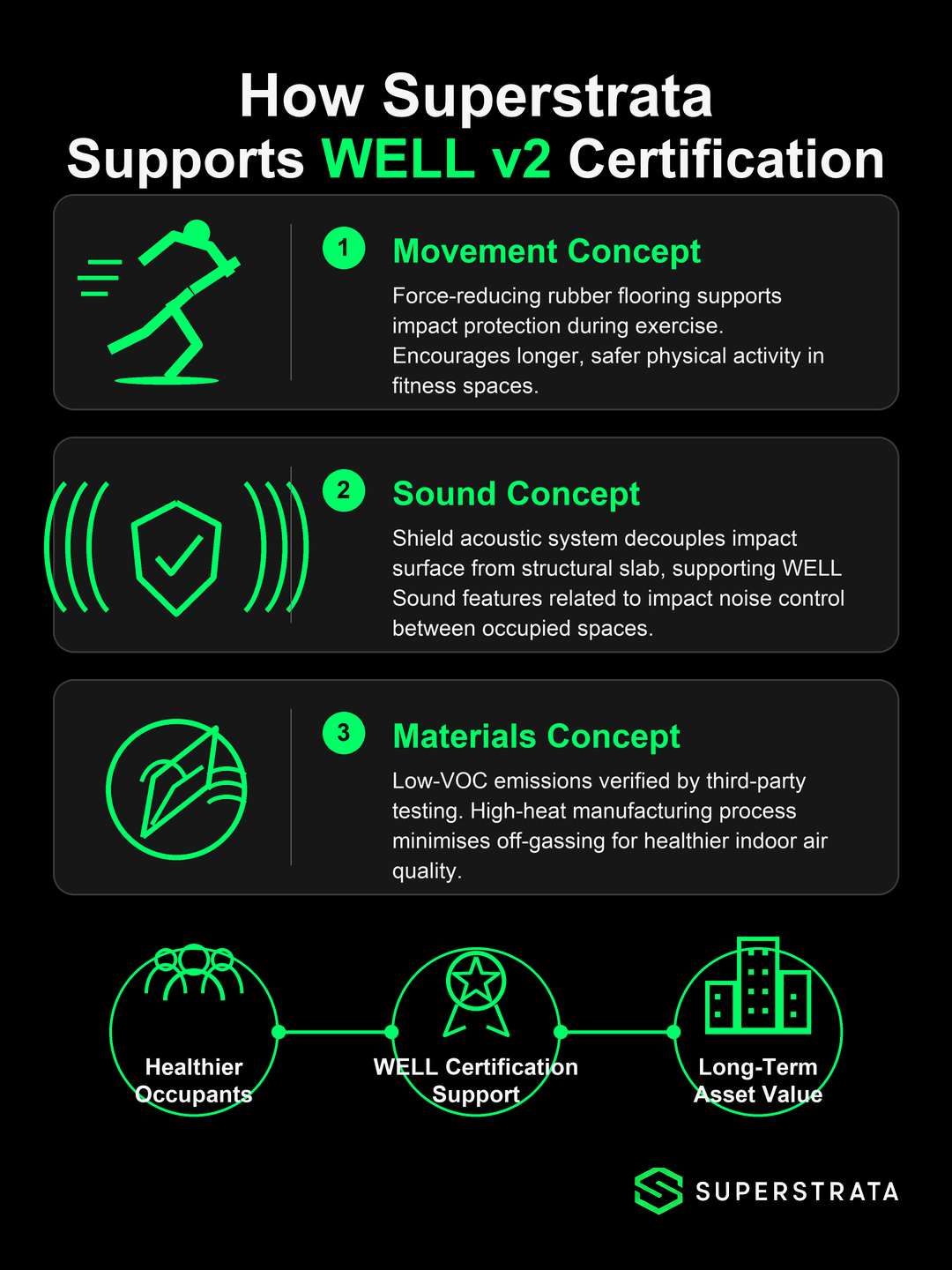
For corporate headquarters, premium residential developments, and high-end commercial gyms, WELL Certification is increasingly built into the project brief. Gym flooring specification interacts directly with three WELL Concepts: Movement, Sound, and Materials.
This guide explains how Superstrata performance rubber flooring supports those three Concepts and helps project teams build a stronger position towards WELL Certification.
1. The Movement Concept
The Movement Concept in WELL v2 aims to promote physical activity and reduce sedentary behaviour through environmental design, programming, and policy.
Providing a fitness space within a building is one part of this. The quality and ergonomics of that space — including the floor — affect whether occupants actually use it and whether they can use it safely over time.
Ergonomic Support
Exercising on concrete or thin, unyielding vinyl causes rapid joint fatigue and increases impact-related injury risk. Superstrata's Pulse and Titan ranges are engineered to absorb impact energy from plyometric movement (such as box jumps, sprints, or sled work) while returning enough energy to keep movement efficient.
This force-reducing performance directly supports the Movement Concept's intent of encouraging regular, safe physical activity by reducing the physical barriers to exercise within the building.
2. The Sound Concept
The Sound Concept aims to bolster occupant health and well-being by managing acoustical comfort. In mixed-use buildings containing fitness facilities, the gym is often the single greatest threat to acoustic comfort in neighbouring spaces.
Sound Mapping and Acoustic Zoning
WELL projects are expected to consider how acoustic zones interact — loud spaces, quiet spaces, and mixed-use spaces — and to design the relationships between them deliberately. A heavy free-weights area is inherently a loud, impact-heavy zone.
Impact Noise Management
Structure-borne noise — the kind generated by a dropped barbell — is one of the most challenging acoustic problems in mixed-use design. Surface-only rubber tiles mitigate the airborne noise of the impact but do relatively little to stop low-frequency vibration travelling through the structural slab into the floors and rooms below.
Superstrata's Shield acoustic system uses a profiled acoustic underlay beneath a dense impact layer. By decoupling the impact surface from the structural slab, it reduces the transmission of structure-borne impact energy. This contributes to the project's ability to meet WELL's impact noise objectives, supporting the acoustical comfort of quiet zones adjacent to or below the gym.
Architects should specify Shield in coordination with the broader acoustic strategy for the building — ceilings, isolation pads, partition design — rather than treating the floor as a standalone solution.
3. The Materials Concept
The Materials Concept aims to reduce occupant exposure to hazardous building material ingredients, with particular focus on indoor air quality.
Volatile organic compound (VOC) emissions from interior materials are a long-standing concern in WELL projects. Cheap, imported rubber flooring is sometimes notorious for off-gassing — the "tyre-shop smell" associated with low-grade crumb rubber.
Meeting WELL VOC Thresholds
To support compliance with WELL's material air-quality requirements, flooring products should be tested by an independent third party and shown to emit low levels of VOCs.
Superstrata products are manufactured using high-quality washed recycled SBR and premium polyurethane binders. The manufacturing process uses a high-heat, high-pressure phase that drives off volatile compounds before the product leaves the factory. Where third-party VOC emissions testing has been completed, certificates are available as part of the technical submittal package. Specifiers should request the current test data for the specific product being installed.
Summary for Specifiers
Achieving WELL Certification requires a holistic approach to material specification. For gym flooring in a WELL v2 project:
- Movement: Specify a floor with proven force reduction to protect occupants' joints and encourage regular use of the fitness space.
- Sound: Where the gym sits above or beside noise-sensitive zones, specify a decoupled acoustic system as part of the wider acoustic strategy.
- Materials: Require third-party VOC emissions data for the specific product being installed, and check that certificates are current.
Aligning the flooring specification with these three Concepts protects occupant health and strengthens the project's overall position towards certification. Final certification outcomes are determined by the WELL assessor against the full set of project requirements.
For technical support on your WELL project, or to request VOC and acoustic test data, contact the Superstrata specification team at info@superstrata.fit.
References
[1] International WELL Building Institute, WELL v2 Standard, Movement Concept. [2] International WELL Building Institute, WELL v2 Standard, Sound Concept. [3] International WELL Building Institute, WELL v2 Standard, Materials Concept.