In the UK commercial fit-out sector, sustainability has shifted from a differentiator to a baseline requirement. For architects and designers specifying gym flooring in mixed-use developments, corporate offices, or public leisure centres, achieving a strong BREEAM (Building Research Establishment Environmental Assessment Method) rating is increasingly written into project briefs and tender documents.
Sustainability documentation from US-focused flooring manufacturers, often referencing LEED v4 or FloorScore, doesn't always align cleanly with UK BREEAM assessment. This guide explains how specifying Superstrata performance rubber flooring can support your project's BREEAM assessment, with a particular focus on Mat 01 (Life Cycle Impacts), Hea 05 (Acoustic Performance), and Mat 03 (Responsible Sourcing of Construction Products).
The Mat 01 Question: Why EPD Format Matters
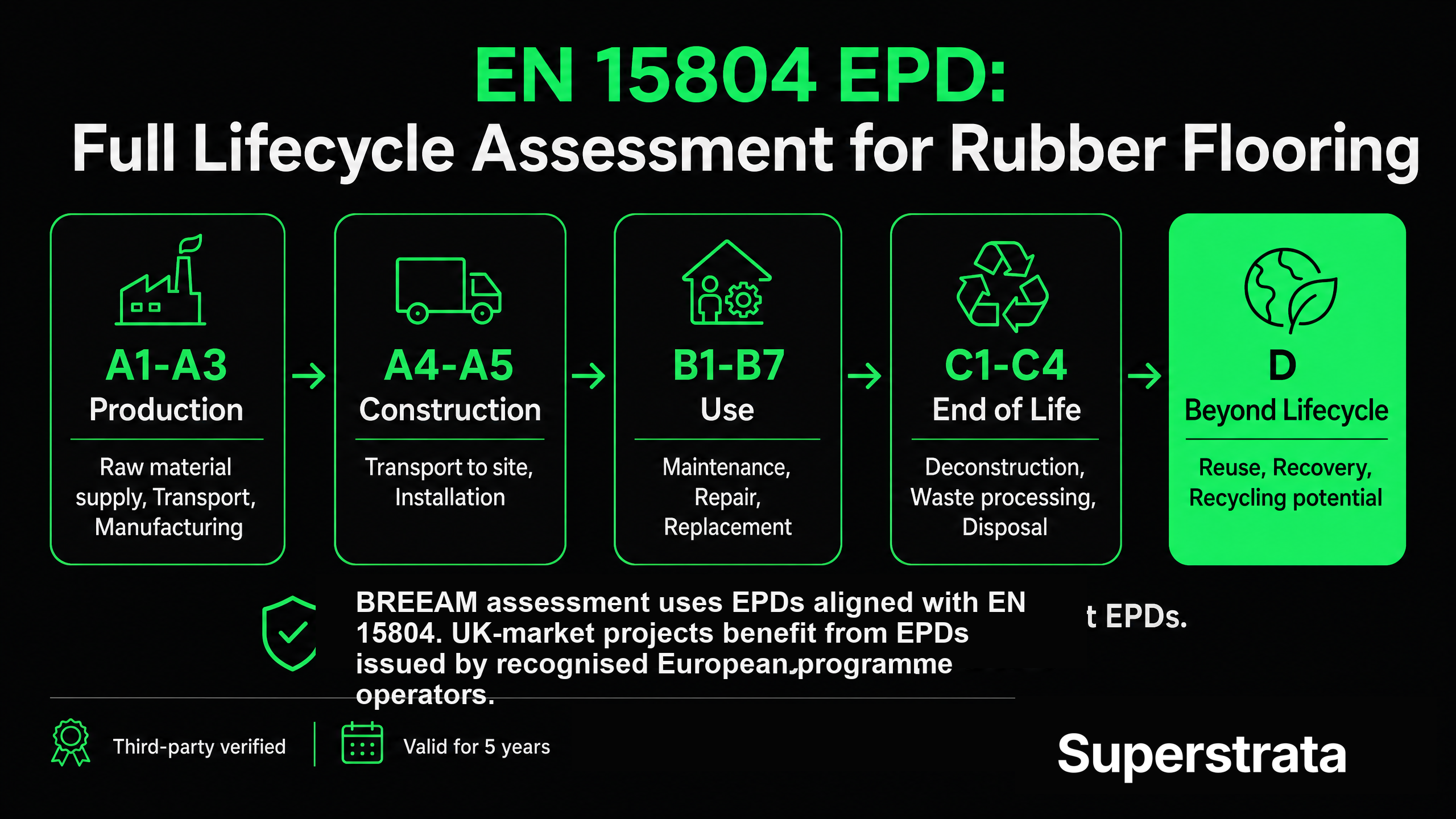
The Mat 01: Life Cycle Impacts issue in BREEAM New Construction is designed to encourage design decisions that reduce the environmental impacts of construction projects. It draws on a project-level Life Cycle Assessment (LCA), which in turn relies on data drawn from Environmental Product Declarations (EPDs).
An EPD is a third-party verified document that communicates transparent information about a product's environmental performance across its lifecycle. The key point for UK specifiers is that BREEAM assessments use EPDs aligned with the European standard EN 15804.
EPDs based on North American Product Category Rules (PCRs) follow a different framework. They aren't automatically excluded from a BREEAM assessment, but they typically need to be cross-walked or interpreted by the assessor, and the data may not slot directly into the LCA calculator without additional work. For specifiers, the practical implication is straightforward: an EN 15804 compliant EPD will integrate more cleanly with UK BREEAM workflows than a US-format EPD.
The EN 15804 Framework
An EN 15804 compliant EPD covers the lifecycle of the flooring product across defined modules:
- A1–A3: Raw material supply, transport, and manufacturing (cradle to gate).
- A4–A5: Transport to site and construction installation.
- B1–B7: Use stage, including maintenance, repair, and replacement.
- C1–C4: End of life — deconstruction, transport, waste processing, and disposal.
- D: Benefits and loads beyond the system boundary (reuse, recovery, recycling potential).
By specifying flooring backed by EN 15804 verified data, architects ensure their materials integrate cleanly into the BRE-aligned LCA tools used at RIBA Stage 2 (Concept Design) and Stage 4 (Technical Design).
How Superstrata Supports Your BREEAM Assessment
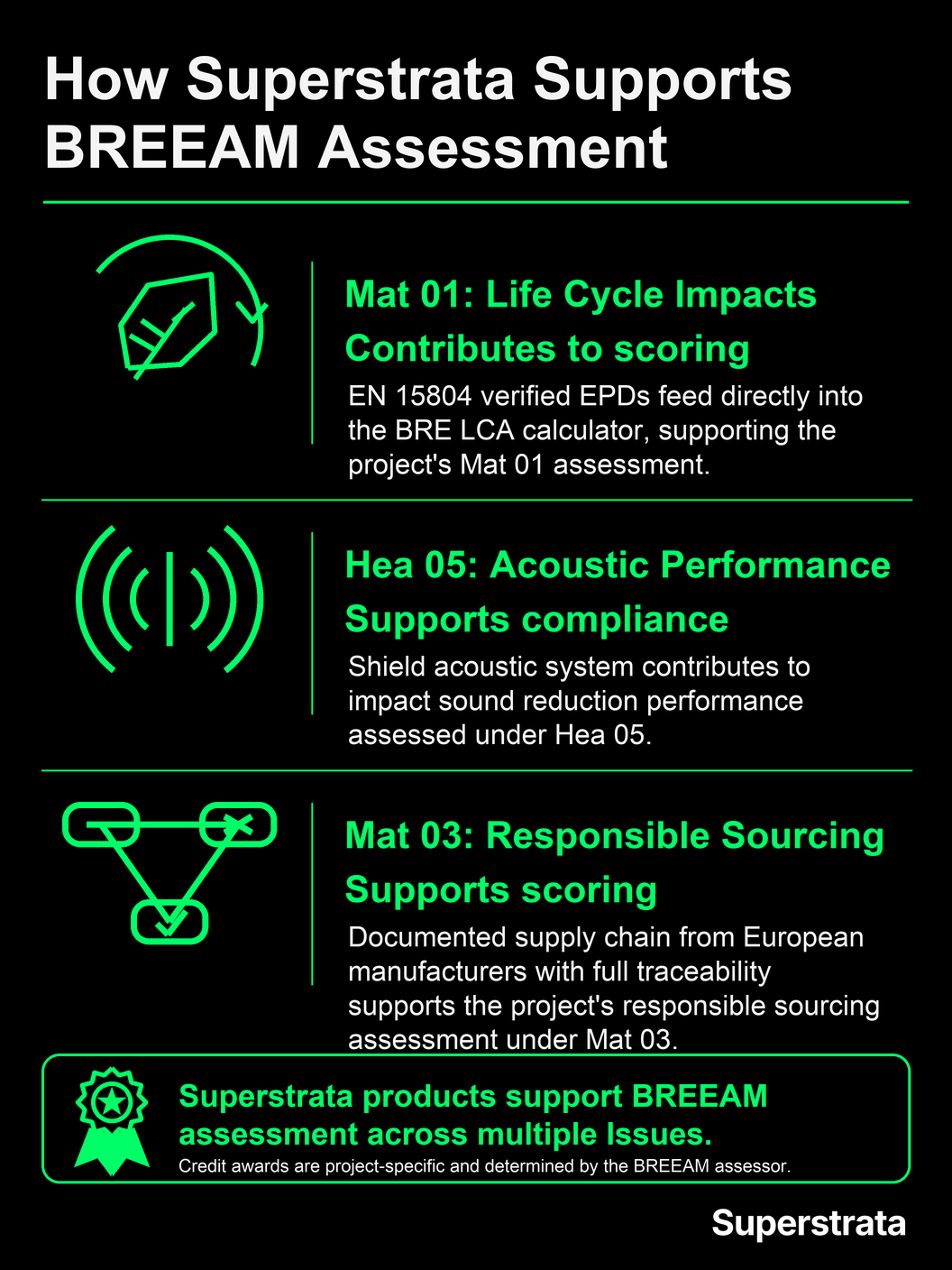
Superstrata flooring can contribute to BREEAM scoring across three relevant Issues. It's worth noting that BREEAM credits are awarded at project level, not product level — what a specifier should expect is for product choices to make a positive contribution to the overall assessment.
1. Mat 01: Life Cycle Impacts
Mat 01 awards credits based on the project's superstructure LCA and options appraisal. Internal finishes, including flooring, are part of that assessment.
When the BREEAM assessor models materials in the LCA tool, products with verified EN 15804 EPDs produce more accurate and recognised data inputs. Superstrata rubber flooring is manufactured from durable recycled SBR (styrene-butadiene rubber) bound with polyurethane, which gives it a competitive embodied carbon profile compared to virgin synthetic alternatives.
Specification Action: Ensure the flooring specification clause (such as NBS M50) explicitly requires an EN 15804 compliant EPD. This protects the integrity of the Mat 01 data inputs during the procurement phase.
2. Hea 05: Acoustic Performance
Hea 05 awards credits for achieving defined acoustic performance standards in occupied spaces. In mixed-use buildings containing fitness facilities, impact noise from gyms — particularly from dropped weights — is one of the harder acoustic problems to solve.
The Hea 05 assessment looks at the building's overall acoustic performance, with flooring being one contributor among several (structural decoupling, ceiling treatments, partition design). Specifying a high-performance acoustic floor system gives the design team a stronger starting point.
Superstrata's Shield acoustic system is engineered to reduce structure-borne impact noise transmission. It contributes to impact sound reduction performance, supporting the wider Hea 05 assessment alongside the building's other acoustic measures, and assists with meeting Building Regulations Approved Document E where the gym sits below or adjacent to residential space.
| Superstrata System | Primary Application | Acoustic Contribution |
|---|---|---|
| Titan (30–40mm) | Heavy free weights | High mass absorbs impact energy from dropped weights at source. |
| Shield Acoustic | Upper-storey gyms | Decouples impact surface from structural slab, reducing structure-borne vibration. |
| Pulse (10–15mm) | Cardio and machine zones | Reduces footfall noise and light impact sound in general workout areas. |
3. Mat 03: Responsible Sourcing of Construction Products
Mat 03 rewards projects that demonstrate the responsible sourcing of materials used in the building. The assessment looks at the proportion of products with recognised responsible sourcing certifications and documented supply chain provenance.
Superstrata works with established European manufacturer partners and maintains documented supply chain traceability. This documentation supports the responsible sourcing assessment under Mat 03, allowing the assessor to evidence sourcing credentials with verifiable data rather than supplier claims.
Specification Action: Request responsible sourcing documentation as part of the technical submittal package, alongside the EPD and test certificates.
A Note on Construction Waste
Adhesive-free interlocking tile systems, such as Superstrata Titan, reduce waste at installation in a way that benefits the contractor's site waste management plan. Loose-lay installation generates no chemical adhesive waste, offcuts can be cleanly recycled, and tiles can be lifted and reused at end of tenancy.
Construction waste is assessed under Wst 01, which sits with the contractor rather than the product specifier — but a product that simplifies clean waste management is an enabler for the contractor's waste reporting.
Summary for Specifiers
When designing a commercial gym in the UK, specification choices made at RIBA Stages 2 and 3 will determine the strength of the BREEAM data position later. To support your project:
- Specify EN 15804: Require EN 15804 compliant EPDs for all flooring products to ensure clean integration with UK BREEAM LCA tools.
- Plan for Acoustics: Where the gym sits above or beside noise-sensitive space, specify a decoupled acoustic system as part of the wider Hea 05 strategy.
- Evidence Responsible Sourcing: Require documented supply chain provenance to support Mat 03.
- Choose Loose-Lay Where Practical: Adhesive-free tile systems support the contractor's construction waste management plan and enable reuse at end of life.
For project-specific BREEAM guidance or to request our EN 15804 EPD and responsible sourcing documentation, contact the Superstrata technical team at info@superstrata.fit.
Credit awards are project-specific and determined by the appointed BREEAM assessor.
References
[1] BRE Global, BREEAM New Construction 2018 Technical Manual. [2] BRE Global, EN 15804 Environmental Product Declarations programme. [3] HM Government, Building Regulations Approved Document E: Resistance to the passage of sound.