Gym flooring is often treated as a Stage 4 finishes decision — selected alongside paint colours and ceiling tiles late in the design process.
In commercial fitness projects, particularly mixed-use schemes or upper-storey gyms, this is a missed opportunity. Heavy-duty acoustic gym flooring is more like a structural and acoustic intervention than a finish. If specification is delayed until RIBA Stage 4, the design team can find that the concrete slab can't accommodate the required acoustic build-up, or that transitions to adjacent areas won't be level.
This guide maps Superstrata gym flooring decisions across the RIBA Plan of Work to support smoother integration and cost certainty.
RIBA Stage 2: Concept Design
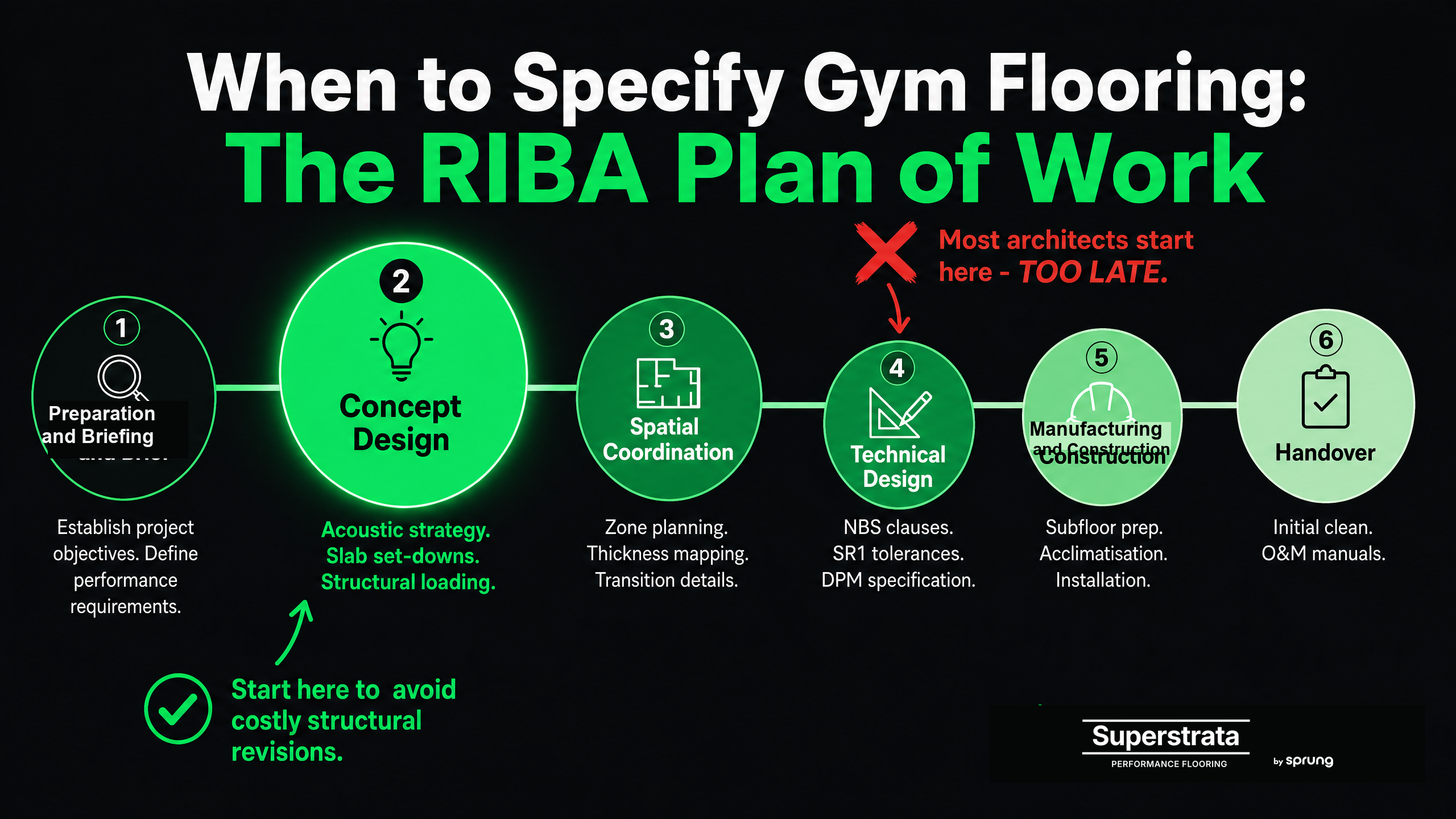
At Stage 2, the architectural concept is approved and primary structural and acoustic strategies are established. For gym flooring, this is the most important stage to engage.
Key Actions
- Acoustic strategy. If the gym is located above or adjacent to noise-sensitive uses (residential, office, library, treatment rooms), engage the acoustic consultant. Establish the impact sound reduction performance the building needs to achieve.
- Slab set-downs. A heavy-duty acoustic gym floor (Superstrata Shield) can require a build-up of 40–60mm. To support level transitions and accessible routes between the gym and adjacent areas, the structural engineer should design a set-down in the concrete slab at this stage.
- Structural loading. The structural engineer should assess the dynamic loads associated with dropped weights to ensure slab design is robust enough to handle impact, even with protective flooring in place.
Superstrata Support at Stage 2: We can supply acoustic test data and system build-up dimensions to inform the structural and acoustic design.
RIBA Stage 3: Spatial Coordination
At Stage 3, the design is coordinated and spatial arrangements are finalised prior to planning submission.
Key Actions
- Zone planning. Divide the gym floor plan into usage zones (cardio, functional, free weights).
- Thickness mapping. Assign the correct flooring thickness to each zone (typically 10–15mm for cardio, 15–20mm for functional, 30mm and above for free weights).
- Transition detailing. Design transitions between zones. Where a slab set-down was not achieved at Stage 2, accessible transition ramps need to be spatially planned now in line with Part M requirements.
Superstrata Support at Stage 3: Zone mapping support and CAD details for transitions and ramps.
RIBA Stage 4: Technical Design
At Stage 4, all information needed to manufacture and construct the project is prepared. This is where the NBS specification is written.
Key Actions
- Write the NBS clause. Lock in the flooring specification. Generic descriptions ("black rubber gym matting") leave the door open to value engineering that can lead to performance failures.
- Specify tolerances. State the required subfloor flatness — BS 8204 SR1 for roll products and acoustic systems.
- Specify moisture control. Require in-situ Relative Humidity testing and the application of a Damp Proof Membrane where RH exceeds 75%.
- Detail expansion gaps. Confirm architectural trims and skirting boards accommodate a 5–8mm perimeter expansion gap.
Superstrata Support at Stage 4: Pre-written NBS clause templates for Titan, Stride, Pulse and Shield systems, available on request.
RIBA Stage 5: Manufacturing and Construction
At Stage 5, the main contractor takes possession of the site and construction begins.
Key Actions
- Subfloor preparation. The screeding contractor prepares the slab to specified SR tolerances and confirms moisture testing.
- Acclimatisation. The building should be weather-tight with HVAC operational. Flooring is delivered to site and allowed to acclimate at 18°C–23°C for 48 hours prior to installation.
- Installation. The flooring contractor installs the Superstrata system according to technical guidelines, using specified low-VOC polyurethane adhesives where bonded installation is required.
Superstrata Support at Stage 5: Detailed installation manuals and technical phone support for the main contractor and flooring installer.
RIBA Stage 6: Handover
At Stage 6, the building is handed over to the client and facility management team.
Key Actions
- Initial deep clean. The flooring contractor or FM team performs the post-installation clean using an auto-scrubber and pH-neutral detergent.
- O&M information. Operations and maintenance information is provided to the client.
Superstrata Support at Stage 6: Cleaning and maintenance protocols for the FM team, designed to protect the warranty and extend the floor's working life.
Summary
By engaging with gym flooring specification at RIBA Stages 2 and 3, design teams avoid the structural revisions, acoustic shortfalls, and transition problems that surface when flooring is treated as a late-stage finish.
To discuss a project currently in Stage 2 or 3, contact the Superstrata specification team at info@superstrata.fit.