The commercial fitness industry uses significant quantities of flooring material. For many years, that meant virgin synthetic materials — poured polyurethane, PVC vinyl — both of which carry environmental burdens in production and at end-of-life.
The specification landscape is shifting. Architects and sustainability consultants are increasingly asking for materials that contribute meaningfully to a circular economy. This guide explains how Superstrata's use of recycled SBR rubber, its manufacturing process, and its end-of-life options support that goal.
The Problem with End-of-Life Tyres
Each year, large volumes of vehicle tyres reach the end of their usable life. Historically many were sent to landfill or incinerated, wasting a highly engineered material and creating environmental cost.
Tyre rubber is built to withstand friction, heavy loads, and severe weather — the same performance characteristics needed for commercial gym flooring. Recovering and reprocessing it into flooring products is a logical second use.
The Superstrata Process
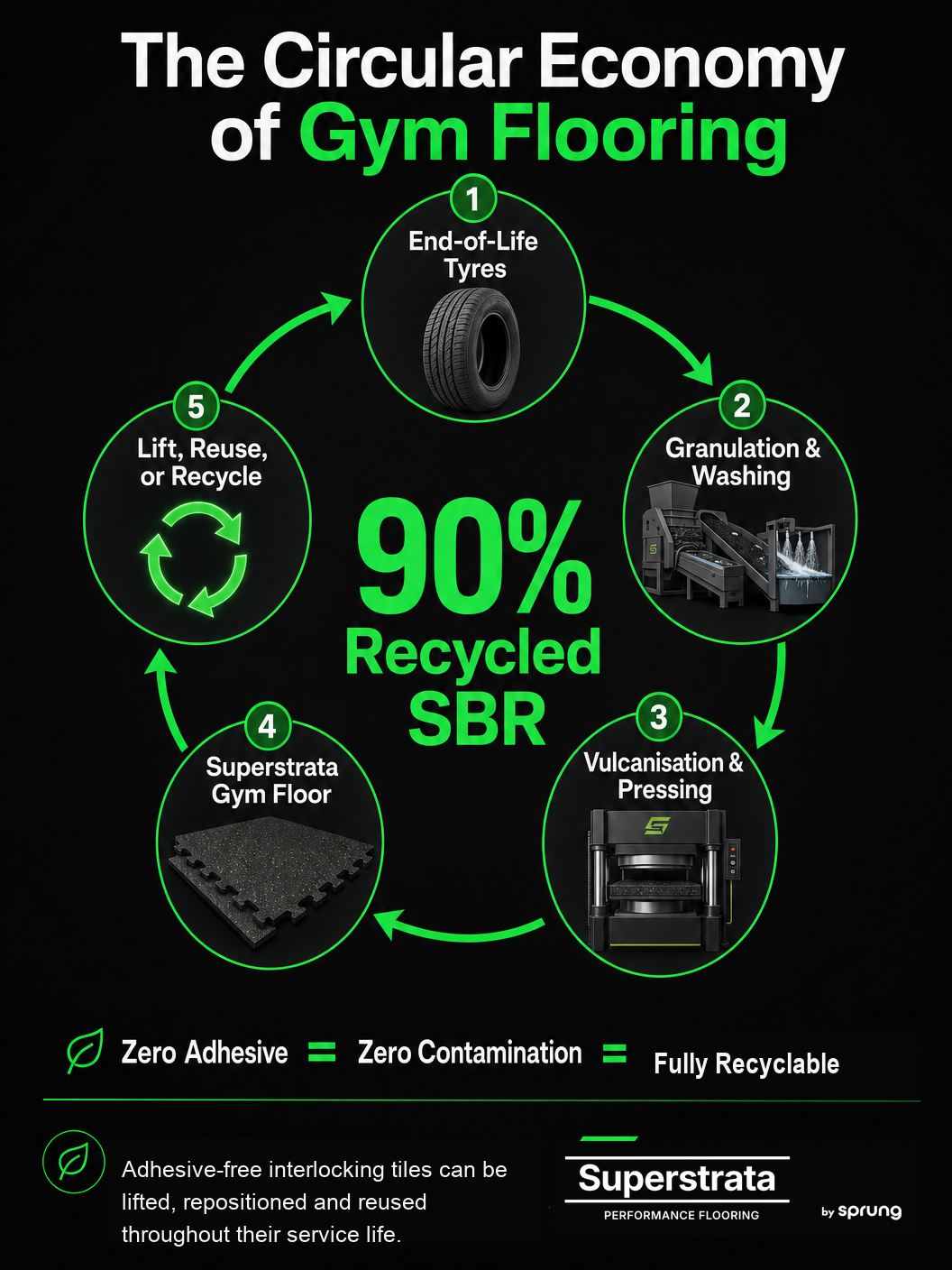
Superstrata's core ranges (Titan, Pulse, Stride and Shield) are manufactured with a substantial proportion of recycled SBR (Styrene-Butadiene Rubber) sourced from end-of-life tyres. Exact recycled content varies by product and finish; current figures for each product are available on request.
1. Sourcing and Granulation
The process begins with diverting end-of-life tyres from landfill. Tyres are mechanically shredded; steel wire and textile fibres are magnetically and pneumatically extracted. The remaining rubber is granulated into specific crumb sizes.
2. Washing and Refinement
What separates premium gym flooring from cheap matting is the washing and refinement of the rubber crumb. Superstrata's SBR is processed to remove dust, oils, and volatile compounds. This reduces residual odour and supports lower VOC emissions in the finished product.
3. Vulcanisation and Pressing
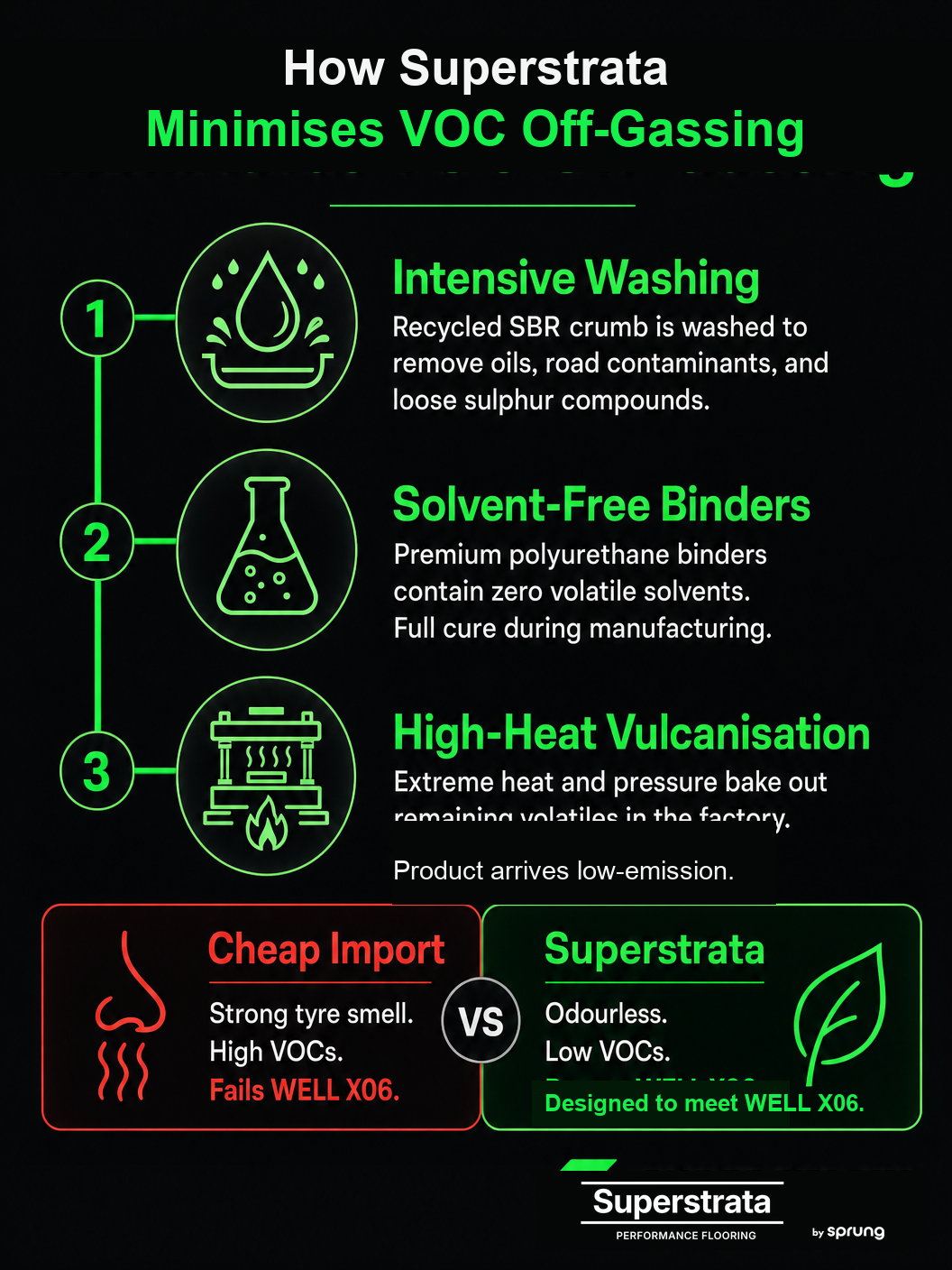
Clean SBR is combined with a polyurethane binder and EPDM colour granules for the wear layer. The mix is subjected to heat and pressure in a vulcanisation press, producing a dense, non-porous, durable tile or roll.
End-of-Life: Towards Circularity
A product's sustainability credentials depend on what happens at the end of its working life, as well as how it was made.
The Adhesive-Free Advantage
Traditional gym floors — thin rubber rolls, vinyl — are typically fully bonded to the subfloor with strong adhesives. When the gym is refurbished or the tenancy ends, the floor has to be mechanically scraped up. This contaminates it with adhesive and screed residue, making clean recycling difficult.
Superstrata Titan and Shield systems are designed as heavy-duty, interlocking or loose-lay tiles requiring no adhesive for installation.
Reuse and Repurposing
Because Titan tiles are not glued, they can be lifted at the end of a tenancy and palletised for reinstallation elsewhere — a new facility, a private gym, or a different commercial setting. This is a practical, low-cost way to extend product life.
Closed-Loop Recycling
When Superstrata rubber finally reaches genuine end-of-life, uncontaminated rubber can in principle be returned to a granulation facility, processed, and used in new products. Closing the loop in this way depends on the rubber not being contaminated by adhesive or installation residue — which is why loose-lay installation matters for circularity, not just convenience.
Specification Summary
When specifying gym flooring for a project targeting BREEAM, WELL, or wider ESG objectives:
- Specify recycled content. Request current recycled SBR content figures for the specific products being installed.
- Specify loose-lay where practical. Adhesive-free interlocking or loose-lay systems support lift-and-reuse and clean recycling at end of life.
- Verify VOC emissions. Request third-party VOC emissions data for the products being installed, particularly important for indoor air quality requirements under WELL.
Specifying Superstrata supports diverting waste from landfill, reducing the embodied carbon footprint of the project's internal finishes, and keeping material in productive use for longer.
For current recycled content data, EPDs, or VOC emissions test certificates, contact the Superstrata technical team at info@superstrata.fit.