In a commercial gym environment, the floor is subjected to sweat, spilled water, dropped chalk, and high-intensity dynamic movement. For architects and facility operators, specifying a floor that is described as "slip resistant" in a brochure isn't enough. Generic marketing claims provide little protection in the event of a slip-and-fall injury.
In the UK, health and safety compliance requires measurable data. The recognised method for assessing the slip resistance of flooring is the BS 7976 Pendulum Test, the method recommended by the UK Health and Safety Executive (HSE) and the UK Slip Resistance Group (UKSRG). This guide explains how the test works, what the results mean, and how Superstrata flooring performs against the relevant thresholds.
The Problem with Generic Claims
Many flooring manufacturers, particularly those focused on the US market, reference coefficient of friction (CoF) figures, ASTM test methods, or general "anti-slip" descriptors. These don't directly correspond to the HSE-recognised UK assessment method.
If a gym member slips and pursues a liability claim, the facility operator (and potentially the specifying architect) needs to demonstrate that the floor was fit for purpose at the time of installation. In UK practice, a current BS 7976 Pendulum Test Value (PTV) certificate from independent testing is the evidence that holds up.
What is the BS 7976 Pendulum Test?
BS 7976 is the British Standard covering the operation and use of the pendulum tester. The test is recognised by the HSE as a reliable method for assessing the slip resistance of pedestrian surfaces, including in conditions where contamination such as water or sweat is present.
How it Works
The testing device features a swinging arm with a rubber slider attached. The pendulum is released from a horizontal position and the rubber slider strikes the floor over a defined contact length. Friction between the slider and the surface slows the pendulum, and the height to which the arm continues after contact is read off a calibrated scale.
This reading is the Pendulum Test Value (PTV). The higher the PTV, the lower the slip potential of the surface.
The test is conducted in both dry and wet conditions. This is critical for gym environments, where sweat, spilled water, and dropped drinks change the slip dynamics of most surfaces.
Understanding PTV Scores
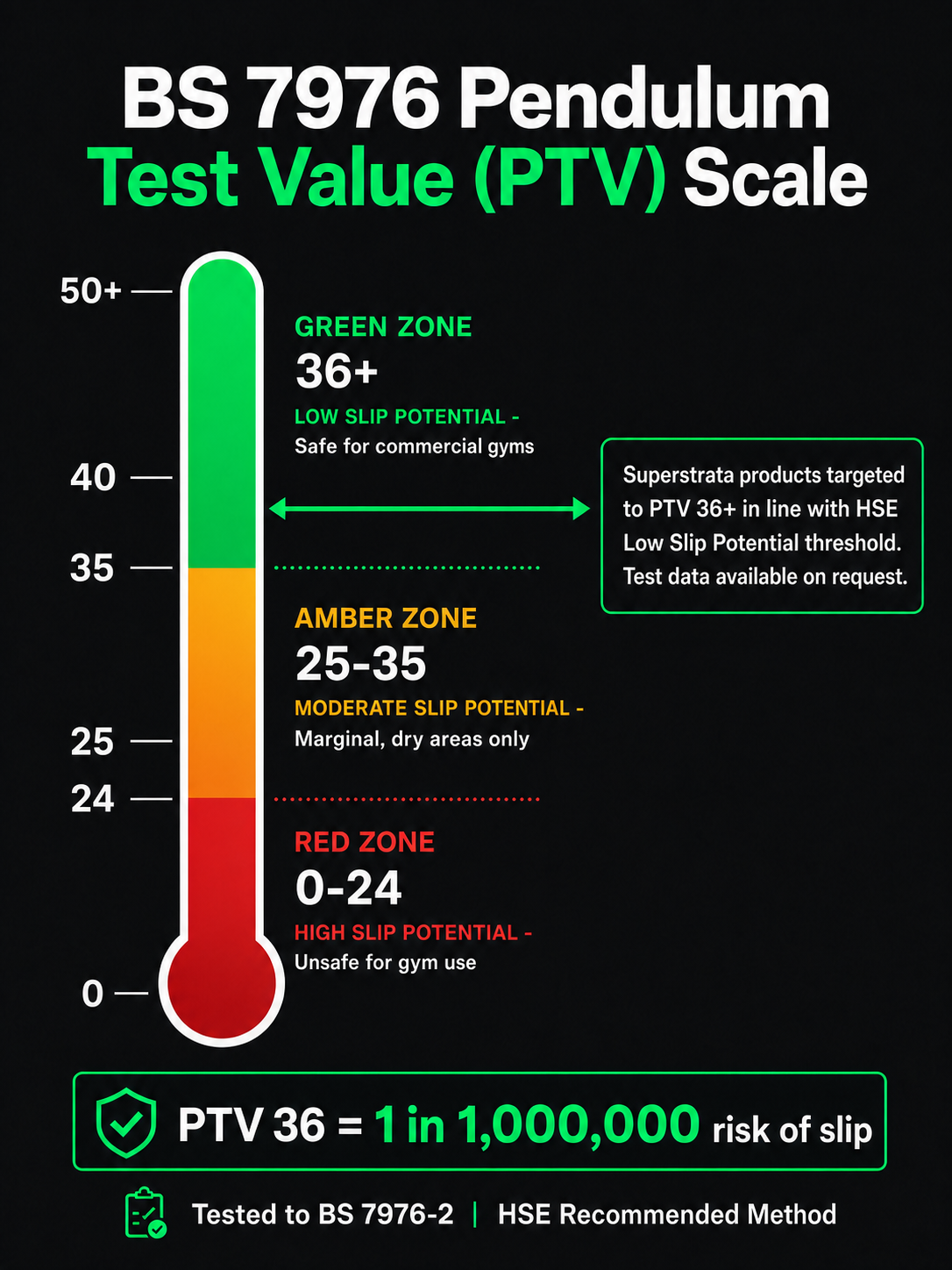
The HSE classifies slip potential against the PTV scale as follows:
| Pendulum Test Value (PTV) | Slip Potential | Suitability for Gym Environments |
|---|---|---|
| 0–24 | High slip potential | Unsuitable for gym applications. |
| 25–35 | Moderate slip potential | Marginal. Acceptable for some dry-only areas, risky in active workout zones. |
| 36+ | Low slip potential | Recommended standard for commercial gym floors, including free-weight and functional training zones. |
A PTV of 36 corresponds to approximately a 1 in 1,000,000 chance of slip under the test conditions. For commercial gym specification, achieving a PTV of 36 or higher in both wet and dry conditions is the appropriate target.
Why Rubber Performs Well in Pendulum Testing
Commercial gym floors are typically rubber, vinyl, or poured polyurethane. Vinyl and PU surfaces can achieve acceptable dry PTV scores, but their performance often drops sharply when wet.
Rubber, by contrast, has a high natural coefficient of friction. Properly formulated commercial-grade rubber flooring tends to perform consistently in both wet and dry conditions because its surface texture provides mechanical grip rather than relying on dry friction alone.
Superstrata rubber flooring (Titan and Pulse) is independently tested to BS 7976-2 and achieves PTV values in the Low Slip Potential band. Current test certificates are available on request and should be reviewed against the specific products being specified.
Specification Best Practices
When writing the flooring specification (e.g. NBS M50) for a commercial gym, leisure centre, hotel fitness suite, or workplace gym, the slip resistance clause should be unambiguous:
- Specify the standard: Require testing in accordance with BS 7976-2.
- Set a clear threshold: Demand a minimum PTV of 36 in both wet and dry conditions.
- Require evidence: Make submission of the independent test certificate a condition of approval at technical submittal stage.
- Confirm certificate currency: Ensure the certificate refers to the specific product and finish being installed, not a generic family certificate.
Superstrata's Approach
Superstrata products are tested to BS 7976-2 by independent UK laboratories, with results provided as part of the technical submittal package. We provide the actual test certificates rather than marketing summaries, so architects, building control officers, and facility operators can evidence compliance directly.
To request BS 7976 certificates for the Superstrata range, visit the Technical Library or contact the specification team at info@superstrata.fit.
References
[1] Health and Safety Executive (HSE), Assessing the slip resistance of flooring, INDG 225. [2] UK Slip Resistance Group, The UK Slip Resistance Group Guidelines, current edition. [3] BSI, BS 7976-2: Pendulum testers — Method of operation.