Historically, when a developer built residential accommodation next to an existing music venue, gym, or other noise-generating use, the existing operator was often pressured to manage the noise problem — sometimes facing restricted hours, costly retrofits, or statutory nuisance action.
The Agent of Change principle has shifted this dynamic. Embedded in the National Planning Policy Framework (NPPF), it places the responsibility for managing noise impact on the party introducing the change, not on the existing use.
For property developers and architects working on mixed-use schemes containing fitness facilities, understanding this principle is important. It shapes how planning is approached and where the cost of acoustic mitigation sits. This guide explains the principle and how Superstrata acoustic flooring systems support compliance.
What is the Agent of Change Principle?
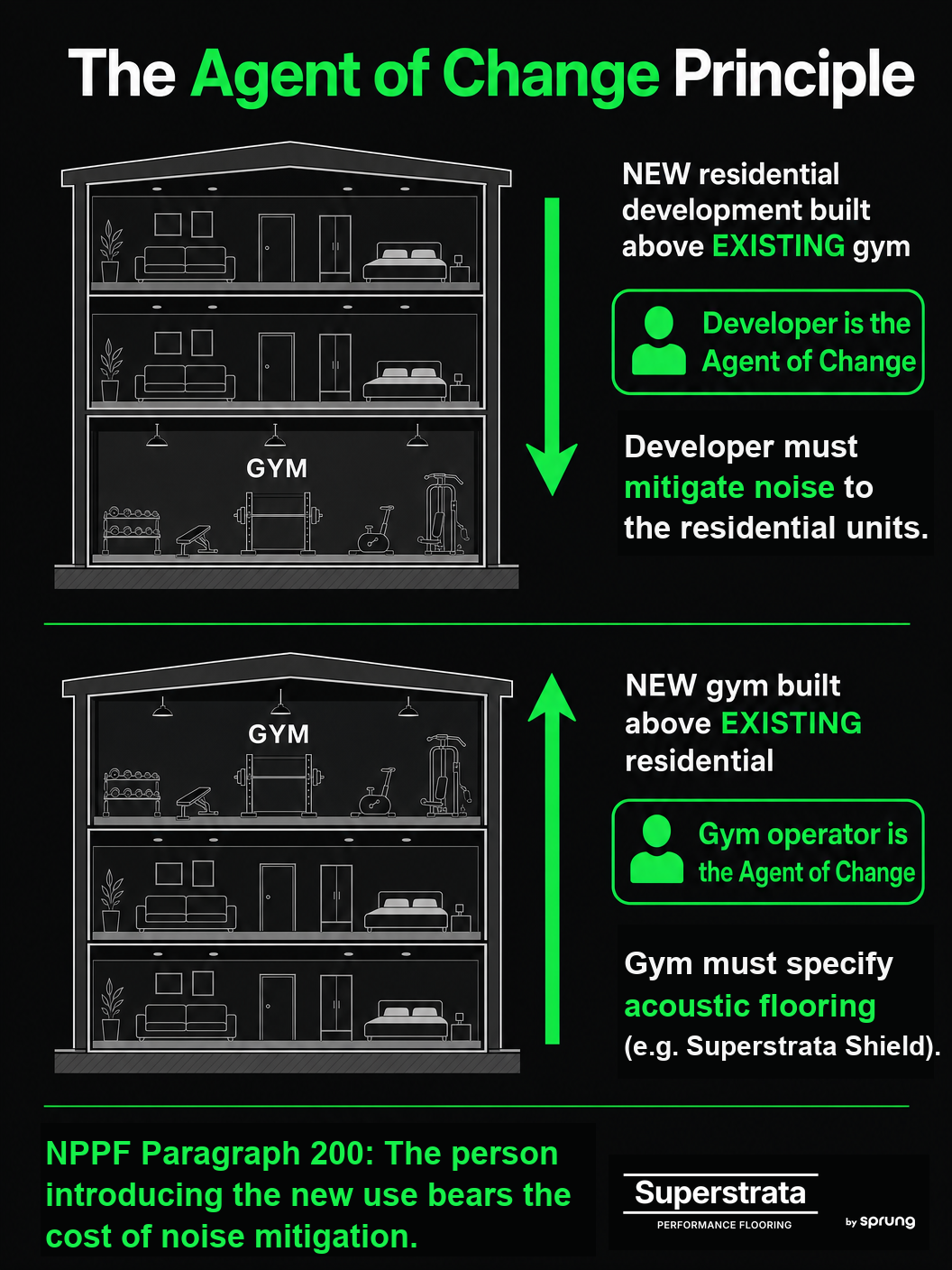
The Agent of Change principle is set out in the National Planning Policy Framework. Successive editions of the NPPF have included it, with the policy reinforcing that responsibility for managing the impact of a change of use lies with the party making the change.
The relevant provision states (paraphrased):
Planning policies and decisions should ensure that new development can be integrated effectively with existing businesses and community facilities. Existing businesses and facilities should not have unreasonable restrictions placed on them as a result of development permitted after they were established. Where the operation of an existing business or community facility could have a significant adverse effect on new development (including changes of use) in its vicinity, the applicant (or 'agent of change') should be required to provide suitable mitigation before the development has been completed.
Scenario A: New Residential Adjacent to an Existing Gym
If a developer builds residential units above or next to an established gym, the developer is the Agent of Change. The residential development must be designed with sufficient acoustic separation that residents are not unreasonably disturbed by the gym's existing operations.
Scenario B: New Gym Within an Existing Building
If a developer or operator fits out a new gym within an existing building containing residential or office uses, the gym operator is the Agent of Change. The fit-out should include acoustic mitigation appropriate to the impact on existing occupants.
In both scenarios, the planning authority can require evidence of mitigation as a condition of approval.
The Challenge of Structure-Borne Noise
In gym environments, airborne noise (music, voices) can usually be managed through standard acoustic partitions and finishes. The harder problem is structure-borne impact noise.
When a heavy barbell is dropped, kinetic energy transfers directly into the concrete slab. Low-frequency vibration travels through the building structure, bypassing airborne acoustic insulation, and re-radiates as audible noise in adjacent spaces.
Building Regulations Approved Document E sets baseline requirements for sound insulation between dwellings and was designed primarily around residential-to-residential noise transfer (footsteps, voices, music). It was not designed around the impact loads associated with heavy free-weight training. Relying on Part E compliance alone for an upper-storey gym is often insufficient — and may not satisfy the planning authority where Agent of Change provisions apply.
Reducing Liability with Superstrata Shield
To address structure-borne impact noise at source, the gym floor needs to be acoustically decoupled from the structural slab.
Superstrata Shield is an acoustic flooring system designed to reduce structure-borne noise transmission in mixed-use developments.
How Shield Works
- Impact layer: A dense, heavy-duty rubber wear layer (typically Titan) absorbs the initial shock of dropped weights and protects the subfloor.
- Decoupling layer: Beneath the impact layer sits a profiled acoustic underlay that acts as a vibration break, reducing transmission of impact energy into the structural slab.
- Result: Kinetic energy is dissipated within the flooring system rather than transferring through the building structure.
Specific impact sound reduction performance (ΔLw) varies by system build-up and substrate condition, and should be confirmed against current test data for the project's structural assembly. Shield acoustic test data is available on request and should be reviewed alongside the wider acoustic strategy for the project.
Specification Actions for Developers
To support planning approval and reduce risk of post-occupancy complaints under Agent of Change provisions:
- Engage an acoustic consultant early. RIBA Stage 2, not Stage 4. The acoustic strategy informs the structural and architectural design, not the other way around.
- Use realistic test data. Request impact test data that reflects gym-relevant loads, not just standard tapping-machine results.
- Specify decoupled systems where appropriate. For upper-storey gyms or gyms adjacent to residential, a decoupled acoustic floor system contributes meaningfully to overall noise control. Standard 10mm or 20mm rubber alone is unlikely to be sufficient.
- Document the mitigation. Keep clear records of the specified system, test data, and installation method for the planning file. This protects the developer if complaints arise post-completion.
For acoustic test data or to discuss a mixed-use development, contact the Superstrata technical team at info@superstrata.fit.
References
[1] HM Government, National Planning Policy Framework (current edition). [2] HM Government, Building Regulations Approved Document E: Resistance to the passage of sound. [3] BSI, BS 8233: Guidance on sound insulation and noise reduction for buildings.