The most common cause of gym flooring failure is not the product itself — it's poor subfloor preparation and incorrect installation. A premium 30mm rubber tile can still fail, gap, or peak if installed over a damp, uneven, or poorly prepared concrete slab.
For architects and main contractors, building rigorous subfloor tolerances and acclimatisation requirements into the specification is critical to delivering a flawless finish. This guide details the technical requirements for installing Superstrata performance rubber flooring.
1. Subfloor Tolerances: BS 8204
Rubber flooring, particularly dense roll formats like Superstrata Pulse, will telegraph any imperfections in the subfloor.
UK subfloor surface regularity is governed by BS 8204, which defines three Surface Regularity (SR) classes measured against a 2-metre straight edge:
- SR3 (±10mm over 2m): Not suitable for finished gym flooring.
- SR2 (±5mm over 2m): Standard for many commercial finishes, but often insufficient for thin rubber rolls.
- SR1 (±3mm over 2m): The highest flatness standard.
Specification Action: For Superstrata roll products (Pulse, Stride) and acoustic underlays (Shield), the subfloor should be prepared to SR1. For heavy-duty interlocking tiles (Titan 30mm and above), SR2 is generally acceptable, though SR1 remains preferred.
If the concrete slab does not meet these tolerances as cast, a heavy-duty self-levelling smoothing compound should be applied prior to installation.
2. Moisture Testing and DPM Requirements
Rubber is non-porous. If installed over a concrete slab still carrying construction moisture, that moisture becomes trapped — leading to hydrostatic pressure on the adhesive bond, blistering or bubbling of the surface, and conditions that support mould.
Relative Humidity (RH) Testing
Before installation, the slab should be tested for moisture using the in-situ RH method (BS 8203 / ASTM F2170). Surface moisture meters are not sufficient on their own.
- Recommended threshold: RH below 75% before installation begins.
- If RH exceeds 75%: A liquid Damp Proof Membrane (DPM) should be applied before the levelling compound and flooring are installed.
Specification Action: State explicitly in the NBS clause that RH testing must be conducted and recorded, and that a suitable DPM must be applied where RH exceeds 75%.
3. Acclimatisation: Preventing Expansion and Gapping
Rubber is sensitive to temperature. It expands when warm and contracts when cold. Installed cold into a warm gym, rubber can expand after installation, causing joints to peak or buckle. Installed hot into a space that later cools, the rubber can contract and leave gaps between tiles or rolls.
Acclimatisation Protocol
- The building should be fully enclosed and weather-tight, with the permanent HVAC system operational.
- Ambient room temperature should be stable between 18°C and 23°C for at least 48 hours prior to installation.
- Rubber flooring should be unrolled (or tiles unboxed) and laid flat in the installation area for 24 to 48 hours before cutting or bonding.
4. Installation Methods
Superstrata offers products designed for different installation methods, selected by zone and substrate.
Fully Bonded (Adhesive)
Required for roll products (Pulse, Stride) and areas subject to heavy wheeled traffic or sled work.
- Adhesive: A high-quality, low-VOC, two-part polyurethane adhesive is typically used.
- Process: Adhesive is trowelled onto the prepared subfloor, the rubber is laid into the wet adhesive, and a heavy floor roller is used to ensure full transfer and remove trapped air.
Loose-Lay / Interlocking
Suited to heavy free-weight zones (Titan 30mm and above) and tenancies where future lift-and-reinstate may be desirable.
- Process: Heavy tiles are laid directly onto the subfloor. Tile mass and interlocking edges keep them in place without adhesive.
- Advantages: No adhesive cost, immediate use after installation, and individual damaged tiles can be lifted and replaced without uplifting the whole floor.
5. Expansion Gaps
Because rubber expands and contracts, a perimeter expansion gap is needed where the flooring meets walls, columns, or fixed equipment.
- Leave a 5–8mm perimeter expansion gap.
- The gap can be concealed with skirting board or architectural trim installed after the flooring.
Summary Checklist for Main Contractors
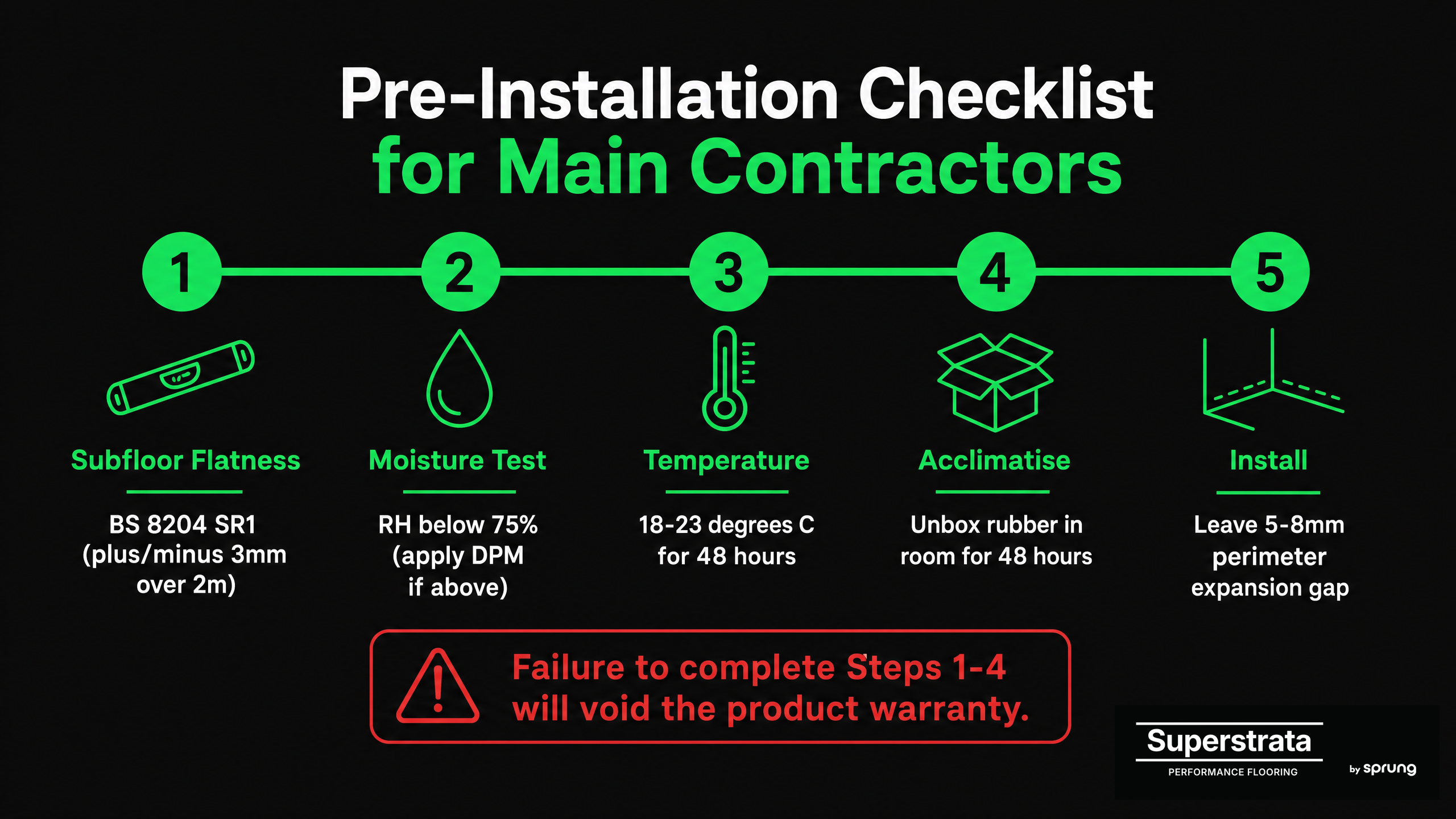
Before authorising the flooring contractor to begin:
- Is the subfloor flat to BS 8204 SR1 (±3mm)?
- Has the subfloor RH been tested and confirmed below 75% (or a DPM applied)?
- Has the ambient temperature been stable at 18°C–23°C for 48 hours?
- Has the rubber been unrolled or unboxed in the room for 24–48 hours to acclimate?
- Have perimeter expansion gaps been factored into the skirting design?
For detailed installation manuals or technical support, contact the Superstrata technical team at info@superstrata.fit.
References
[1] BSI, BS 8204-1: Screeds, bases and in situ floorings. [2] BSI, BS 8203: Code of practice for installation of resilient floor coverings.